How Did They Build Stonehenge Without Technology? Methods Explained
A masterclass in planning, muscle power, and precision.
How did they build stonehenge without technology? The short answer is that they used a sophisticated mix of human labor, local materials, and time-tested engineering knowledge—long before the age of machines. Stonehenge was not the product of “mysterious tech,” but of systematic problem-solving: sourcing stone, moving it over difficult terrain, raising it with simple yet effective methods, and arranging it with remarkable care.
Today, archaeologists and engineers study how such work could have been accomplished using only hand tools, ropes, timber, and coordinated crews. While not every detail is fully proven, the overall workflow is clear enough to show how a community could build a monumental stone circle without modern equipment.
How did they build stonehenge without technology? The overall construction strategy
To answer how did they build stonehenge without technology, it helps to think in phases. Large earthworks, heavy stonework, and precise alignment were likely handled through repeating cycles of preparation and construction. Each phase depended on the next: the ground had to be prepared before stones were raised, and stones had to be placed carefully before final packing and finishing.
A likely high-level sequence looks like this:
- Plan the site by selecting the location and establishing reference points.
- Source stones and prepare transport routes.
- Cut and shape blocks enough for practical handling.
- Move stones using rolling, sledging, waterways, and manpower.
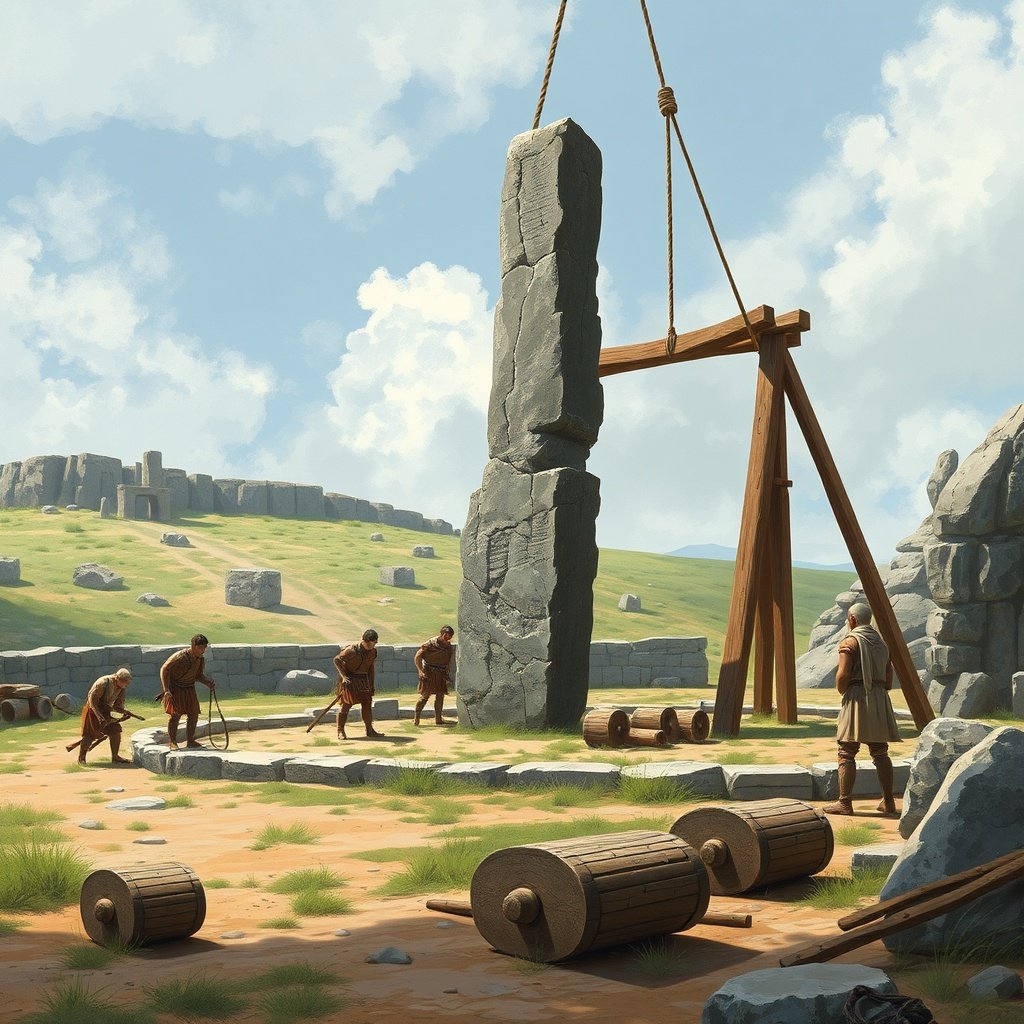
- Raise uprights with timber frameworks, levers, and ropes.
- Align the stones during placement using sighting and measuring methods.
- Backfill and stabilize with packing material for long-term stability.
Toolkits that were “low-tech” but highly capable
Stonehenge’s builders worked with materials and tools appropriate to a prehistoric economy. They didn’t need electricity or motors to handle heavy tasks; they needed durable implements and practical designs that reduced friction and improved leverage.
Cutting, dressing, and finishing
To extract stone and prepare it for transport, crews likely used tools made from harder stone and metal (where available). Common approaches would include:
- Chisels and hammerstones to detach blocks from the bedrock.
- Repeated shaping to create usable faces and consistent dimensions.
- Trial fitting during erection so stones could be adjusted into place.
Even if the stones were not “precision machined” to modern tolerances, they only had to be accurate enough for stable placement and the intended visual geometry.
Ropes, levers, and timber frameworks
Handling massive stones without machinery is mostly about managing weight. The builders would have relied on:
- Ropes and bindings for pulling, controlling direction, and staging.
- Levers and rollers to convert heavy loads into manageable motions.
- Timber A-frames or scaffolding to lift uprights safely.
- Wedges and packers to stabilize stones once positioned.
These are classic engineering tools: none require “technology” in the modern sense, yet each one improves control and reduces the forces needed from individual workers.
Quarrying: extracting the right stone in the right way
Stonehenge used different stone types, each with a distinct origin and transport challenge. The ability to identify good stone and extract it efficiently would have been essential.
Working with natural seams and fractures
Quarrying pre-industrial stone often involves exploiting weaknesses in the rock. Builders could locate seams, use hammering to propagate cracks, and separate blocks. The goal would not be perfectly uniform slabs from the start, but blocks that could be handled and transported with tolerable effort.
Creating a workable “stone workflow”
Quarrying wasn’t likely a one-day task. It would have been organized as a production system—people assigned to find, detach, rough-shape, and bundle stone for shipment.
- Surveyers would identify quality and workable extraction sites.
- Quarry crews would detach stones using repetitive tool actions.
- Shaping teams would reduce irregularities to ease movement.
- Transport coordinators would schedule departure times and routes.
This “industrial” thinking—divide labor, repeat steps, improve efficiency—answers much of the mystery behind how did they build stonehenge without technology: the builders treated construction like an organized campaign rather than a single improvisation.
Transporting massive stones across land and water
Transport is often the hardest part of any monument-building project, especially without modern vehicles. Yet many heavy-lifting traditions across history show that distance is conquerable when you combine routes, friction-reduction, and coordinated force.
Rolling and sledging over land
For overland movement, a plausible method involves dragging or sledging stones on prepared surfaces. Even with rough ground, the team could improve mobility by:
- Placing logs or rollers under the stone to reduce friction.
- Using sled runners and pack layers (sand, gravel, or grass) to stabilize travel.
- Moving in stages so different teams handle segments efficiently.
Rock mass doesn’t “move itself.” But with repeated manpower shifts and careful ground management, it becomes possible to move large loads across considerable distances.
Water transport as a major advantage
Where rivers or coastal routes were available, water could dramatically simplify movement. Water transport reduces friction compared to land movement and allows larger groups to coordinate pulling from boats or rafts.
Many reconstructions propose that the builders used waterways for at least part of the journey, transferring stones between land segments where necessary. If you picture the project as a chain of short transport problems rather than one long haul, the overall plan becomes more plausible.
Lifting and setting uprights with simple engineering
Raising a tall stone upright is a matter of controlling overturning forces. Without cranes, the builders likely used timber structures and step-by-step leverage, creating a safe system to bring the stone from horizontal to vertical.
Timber frames and controlled rotation
A common prehistoric approach is an A-frame or tripod-like timber arrangement. In such a setup, ropes could pull the stone upward while workers guide it to prevent sideways slippage. Once near vertical, wedges and packing material can hold it in position while the team adjusts alignment.
Using the ground as a “construction partner”
Even without advanced surveying instruments, the builders could exploit earthworks to stabilize placement. Preparing sockets or trenches, then packing around stones, turns unstable lifting moments into a more controlled set.
The key is that the stone doesn’t need to land perfectly on the first attempt; the site design could accommodate minor repositioning before final packing.
Alignment: precision without modern measuring tools
Stonehenge’s layout—especially the circular arrangement and the relationships between stones—suggests careful placement and repeated checks during construction. How did they achieve this kind of geometric consistency without electronic tools?
Sighting, reference lines, and repeated placement
Builders could use direct sighting methods: aligning stones with known reference points in the landscape. They might use temporary markers, cord lines, and disciplined measurement routines based on local, repeatable geometry.
- Establish a baseline using stakes or stone markers.
- Use sight lines to judge angles while positioning uprights.
- Repeat the process for each stone so errors don’t compound.
- Adjust during packing once the stone is standing but before the area is fully stabilized.
Why “good enough” engineering still produces impressive results
It’s worth emphasizing that prehistoric alignment likely targeted functional and ceremonial geometry rather than microscopic precision. Even moderate angular control, applied repeatedly around a circle, can create an overall structure that looks deliberate and consistent to later observers.
Middle-phase construction: how crews organized the work
When people ask how did they build stonehenge without technology, they often picture a single “lifting moment.” In reality, the project depended on ongoing organization—food supply, shift scheduling, maintenance of tools, and constant coordination between quarry, transport, and building teams. The middle stages would have been where complexity was most visible: moving stone into position is easier than keeping the whole machine of labor running for months or years.
Possible organization features include:
- Specialization by role (cutters, haulers, rope handlers, stone-setters).
- Standardized routines so teams could reproduce procedures reliably.
- Training and experience gained through repeated similar tasks.
- Tool stockpiling to avoid delays from damaged or worn equipment.
In other words, the “technology” was social as much as mechanical: a coordinated workforce with shared knowledge and a plan for turning raw material into a standing monument.
Finishing, stabilization, and long-term durability
A major portion of the work would not be glamorous but essential: making sure stones stayed where they were. Pre-modern construction often suffers when foundations shift. Stonehenge’s durability indicates that the builders took stabilization seriously.
Backfilling and packing
After each upright was set, builders likely packed the base with suitable material. Packing reduces movement and helps the stone seat firmly. It also helps distribute pressure so the stone doesn’t rock over time.
Managing drainage and ground conditions
Water can undermine any earthen foundation. Even without modern drainage engineering, builders could improve stability through site preparation—grading ground, compacting layers, and selecting packing materials that drain reasonably well.
This kind of practical site management shows that how did they build stonehenge without technology is as much about maintenance and foundation thinking as it is about dramatic lifting.
How long did it take? What can be inferred
Exact timelines are difficult to establish because monuments often evolve through multiple building campaigns. Rather than assume one continuous construction session, many reconstructions treat Stonehenge as a project with phases. That matters because phased construction makes the challenge more manageable: each campaign can focus on a specific component, and later work can correct and enhance earlier sections.
Even if the total effort spanned many years, the process remains plausible when you consider that labor and planning can be scaled and repeated.
FAQ
Did they really do everything with only hand tools?
They likely relied primarily on hand tools, ropes, and timber frameworks. The evidence supports the idea that they had practical means to cut, move, lift, and set stones without cranes or engines.
How did they move stones without trucks or machines?
Most reconstructions emphasize rolling and sledging over land, combined with water transport where possible. Using rollers, prepared travel surfaces, and large teams can make heavy loads transportable over long distances.
How could they lift standing stones safely?
A controlled timber framework with ropes can raise a stone gradually. Once near vertical, wedges and packing can hold it in place while the crew makes alignment adjustments.
How did they achieve the monument’s alignment?
Likely methods include sighting, reference points, and repeatable placement routines. Accuracy would improve as teams learned the process and adjusted stones during installation.
Conclusion: understanding how did they build stonehenge without technology
How did they build stonehenge without technology? They built it by combining careful planning with proven engineering practices: quarrying suitable stone, transporting it through land-and-water routes, lifting uprights with timber and ropes, and setting each stone with deliberate alignment and stabilization. The “advanced” part wasn’t electronic devices—it was the ability to coordinate people, manage logistics, and apply consistent construction methods over many steps.
When you view Stonehenge as a phased project driven by labor organization and practical mechanics, the feat becomes less like a miracle and more like a high-achievement engineering effort made possible by human ingenuity.